
The Himalayas have a strange way of changing the way we look at the world.
As someone who has spent years studying science, sociology and preparing for competitive examinations, I have become accustomed to understanding the world through facts, theories, data and arguments. But mountains work differently. They do not give you answers in paragraphs or textbooks. They make you walk for them.
The Kuari Pass Trek is one such experience.
Located in the Garhwal Himalayas of Uttarakhand, Kuari Pass reaches an altitude of around 3,815 metres (12,516 ft) and is officially classified as a moderate trek by Uttarakhand Tourism. It is also popularly associated with the historic Lord Curzon’s Trail.
But for me, Kuari Pass is much more than an altitude figure or a trekking route.
It is a journey through forests, bugyals, villages, history and, ultimately, one’s own thoughts.
Kuari Pass: A Different Kind of Himalayan Experience
There are Himalayan treks that are famous because of a summit. There are others that are remembered because of a lake, a valley or a particular landscape.
Kuari Pass is special because the journey itself becomes the destination.
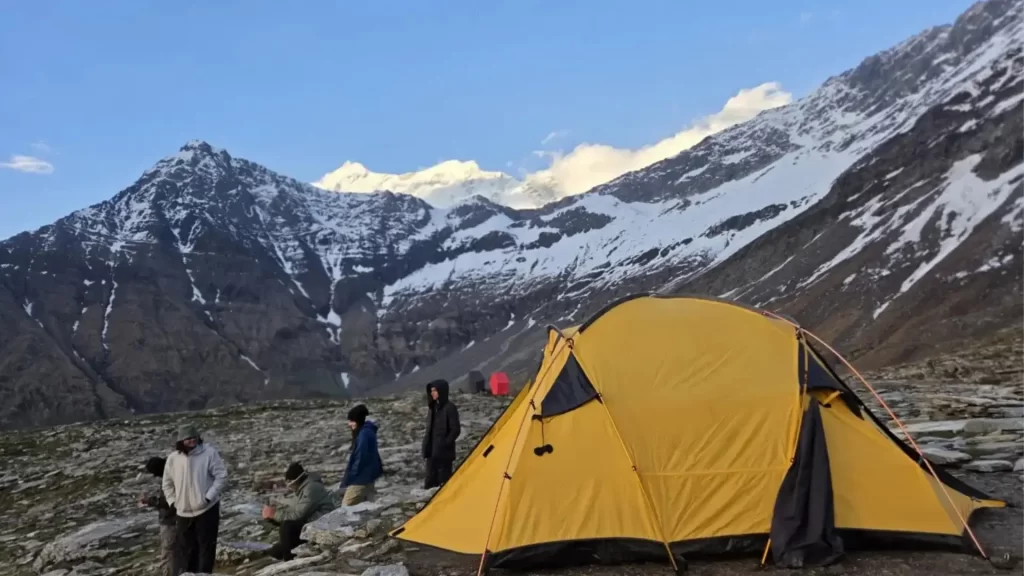
The trail takes you through the beautiful landscapes of the Garhwal Himalayas, with forests, alpine meadows and wide-open mountain ridges. On clear days, the landscape opens towards some of the most magnificent Himalayan peaks, including Nanda Devi, Dronagiri and Chaukhamba.
For a science graduate, there is something fascinating about watching the landscape change with altitude.
At lower elevations, you walk through forests. As you climb, the trees gradually become less dominant and the landscape opens into meadows. Temperature, vegetation, oxygen availability and weather all begin to influence the way you move.
What looks like a simple walk is actually a living lesson in ecology, geography and adaptation.
And perhaps that is what makes trekking so beautiful: you don’t merely read about nature—you experience its systems directly.
Walking Through the Lord Curzon Trail
Kuari Pass is often called the Lord Curzon Trail, connected with Lord George Curzon, the British Viceroy of India, who travelled through this region in 1905. The historical trail was considerably broader than today’s standard Kuari Pass trekking routes.
For me, this historical connection adds another layer to the trek.
As someone who has spent years studying history and preparing for civil services, I have always been interested in the relationship between geography and society.
Mountain geography has never been merely about mountains.
It has influenced migration, trade, agriculture, settlement patterns, culture and political history.
When you walk through the Garhwal Himalayas, these connections become easier to understand. Villages are not randomly located. Trails are not merely recreational paths. Meadows have traditionally been connected with pastoral life, while forests have supported communities for generations.
The landscape becomes a textbook—but this time, the textbook is under your feet.
From Joshimath to the High Mountains
Modern Kuari Pass itineraries commonly approach the trail from the Joshimath–Dhak/Auli side, depending on the route chosen. Different operators use different route variations, so distance and day-wise schedules can differ. Uttarakhand Tourism lists a route reaching Kuari Pass through Khullara and Tali, with the pass at approximately 3,815 metres.
One of the most rewarding aspects of the trek is this gradual transformation of scenery.
You begin surrounded by the character of the lower Himalayas.
Then come the forests.
Then the meadows.
Then the high ridges.
And finally, the pass.
The physical distance may be measured in kilometres, but the psychological distance feels much greater.
Every day you leave something behind.
The noise of the city.
The notifications on your phone.
The pressure of work.
The constant demand to think about tomorrow.
Eventually, there is only the trail, your backpack, your breathing and the person walking beside you.
What Kuari Pass Taught Me as a Student of Sociology
Sociology has taught me to look at society not just as individuals, but as relationships between people, institutions, culture and environment.
The mountains gave me a different perspective on that relationship.
A trek is a temporary society.
People from completely different backgrounds start walking together. A student may walk beside a businessman. A first-time trekker may share a camp with an experienced mountaineer. Age, profession and social status become less important.
The mountain creates a new hierarchy.
Here, the person who walks patiently matters.
The person who helps another trekker matters.
The person who understands that the mountain cannot be rushed matters.
And the strongest person is not necessarily the one who walks fastest.
Sometimes, strength is simply the ability to slow down.
That is one of the most valuable lessons I have taken from the Himalayas.
The Scientific Side of Trekking
My science background also makes me look at trekking differently.
Altitude is not just a number.
At Kuari Pass, the highest point is around 3,815 metres, which means the body has to adapt to a substantially different environment from the plains.
Your breathing changes.
Your pace changes.
Your body begins to remind you that altitude cannot be negotiated through motivation alone.
This is why a responsible trek should never be treated as a race.
Acclimatization, hydration, appropriate pacing, weather awareness and listening to your body are essential parts of high-altitude trekking.
The mountain does not care how fit you think you are.
It rewards preparation.
The Best Time to Experience Kuari Pass
Kuari Pass changes dramatically with the seasons.
Spring and early summer can bring rhododendron blooms, greenery and patches of snow at higher elevations. May and June generally offer a combination of comfortable trekking conditions and impressive mountain scenery.
After the monsoon, September to November is particularly attractive for those looking for clear Himalayan views. Autumn brings crisp air and excellent visibility across the high peaks.
Winter transforms the landscape again.
Snow covers the trail and meadows, temperatures fall sharply and the character of the trek becomes more demanding.
This is one reason I would not describe Kuari Pass simply as a destination.
It is different every season.
The same mountain can tell you a completely different story depending on when you arrive.
Why Kuari Pass Is More Than a Beginner Trek
Kuari Pass is often described as an easy-to-moderate or moderate Himalayan trek and is considered accessible to fit beginners.
But calling it beginner-friendly should never mean calling it effortless.
There are long walking days, altitude gain, uneven terrain, changing weather and physically demanding sections.
The beauty of Kuari Pass is that it provides a meaningful Himalayan challenge without requiring you to be an expert mountaineer.
For someone attempting their first high-altitude Himalayan trek, it can become an introduction to a much larger world.
And perhaps that is why I would recommend it—not because it is easy, but because it teaches you how to become comfortable with being uncomfortable.
The View From Kuari Pass
Eventually, you reach the pass.
And then something happens.
You stop calculating.
You stop checking how many kilometres are left.
You stop thinking about the next deadline.
You simply look.
The enormous Himalayan peaks appear across the horizon, and suddenly the things that occupied your mind a few hours earlier seem strangely small.
As someone who has spent years preparing for examinations, I have often thought about achievement in terms of outcomes—marks, ranks, selection and success.
The mountains have given me another definition.
Sometimes the achievement is not reaching the highest point. It is becoming a different person while walking towards it.
That is the perspective I carry from Kuari Pass.
Kuari Pass: A Journey Into the Garhwal Himalayas
For me, Kuari Pass represents the best combination of adventure, nature, history, science and society.
You get forests and meadows.
You get Himalayan views and mountain villages.
You get a historic trail and a physically demanding journey.
But most importantly, you get time away from the artificial speed of modern life.
In our everyday lives, we are constantly encouraged to move faster.
The mountains teach the opposite.
Walk slowly. Observe carefully. Respect the environment. Help the person beside you. And understand that reaching somewhere is only one part of the journey.
Perhaps that is the real meaning of Kuari Pass.
It is not simply a pass in the Himalayas.
It is a passage—from noise to silence, from information to experience, and sometimes, from knowing ourselves intellectually to understanding ourselves personally.
And when you finally look back at the trail you have walked, you may realize that the mountain was never only testing your legs.
It was testing your perspective.
Plan Your Kuari Pass Trek with The Mountain Hike
If you are looking for an experience that combines Himalayan landscapes, alpine meadows, forests, mountain views and the historic Lord Curzon Trail, Kuari Pass deserves a place on your trekking list.
The Mountain Hike helps trekkers experience the Himalayas with local knowledge, experienced trek leaders and a focus on responsible trekking.
Kuari Pass is waiting. The question is—are you ready to walk?